
Two datasheets sit on your desk. One supplier lists “acrylic monomers” and the other lists “acrylate monomers.” The product lines overlap, but they are not identical, and neither datasheet says which family a given monomer belongs to.
Formulators often face unclear labels on supplier pages, datasheets and quotes. Choosing the wrong sub-family can lead to the wrong material reaching the lab. This guide explains the practical difference between acrylates and methacrylates, the properties affected by that choice, and how to select the right option for your application. It also covers what to ask a supplier before ordering samples, including key details for an acrylate monomer.
What Is an Acrylate Monomer?
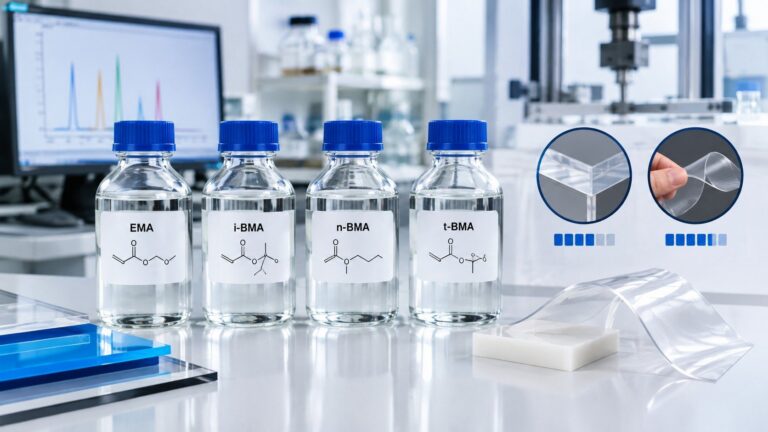
Acrylate monomers are esters of acrylic acid. Methyl acrylate, ethyl acrylate and butyl acrylate are the standard examples, and each name tells you the alcohol side of the ester. Every acrylate carries a vinyl group that polymerizes by free radicals, plus a side chain that sets how the finished polymer behaves. The parent acids, acrylic acid (AA) and methacrylic acid (MAA), also count as acrylic monomers, and their carboxyl groups add adhesion and crosslinking sites to a copolymer.
Acrylates tend to form soft, flexible polymer segments with a low glass transition temperature (Tg). That is why they serve as the flexible, tacky component in coatings and adhesives. Butyl acrylate shows the pattern: Ruifen’s Butyl Acrylate (BA) page lists a Tg of about -54 degrees Celsius and names surface coatings and pressure-sensitive adhesives among its applications.
The side chain matters as much as the family. A bulky ester group raises Tg, so an acrylate can turn out hard, and the performance section below shows an example.
What Is an Acrylic Monomer, and How Does It Differ?
“Acrylic monomer” has no single meaning on supplier sites. Some suppliers use it as an umbrella for acrylic acid, methacrylic acid and their esters. Others mean methacrylates only, so the same phrase covers two different product sets. Treat the term as unreliable until the datasheet names the exact monomer.
Methacrylates such as methyl methacrylate and butyl methacrylate carry an extra methyl group next to the carbonyl. That group stiffens the polymer chain, so methacrylate polymers show higher Tg, harder films and different weathering behaviour than the matching acrylates. Ruifen’s Butyl Methacrylate (BMA) page gives a Tg of about 20 degrees Celsius, against -54 for butyl acrylate. Both monomers carry the same n-butyl group, so the methyl group accounts for a gap of about 74 degrees. Published Tg values vary with source and test method, so use any single figure as a guide and confirm it against the supplier’s technical data sheet (TDS).
Check the datasheet for vague wording. For example, “acrylic monomer” without a monomer name, calling a methacrylate an “acrylate,” or listing only a trade name on the SDS can make it difficult to identify the material clearly.
The CAS number removes the ambiguity. Butyl acrylate is 141-32-2 and butyl methacrylate is 97-88-1, and both names sound alike on a quote. A formulator who orders by a loose phrase can receive either one, and the wrong sub-family means the wrong hardness, flexibility and weathering profile in the film.
Key Performance Differences That Affect Formulation
Glass transition temperature. Family sets the starting point, and the side chain moves it. Methacrylates raise Tg. Longer or branched alkyl chains on acrylates lower it. Bulky cyclic groups raise it again: Ruifen’s Isobornyl Acrylate (IBOA) page lists a Tg of about 90 degrees Celsius for an acrylate, with viscosity of 5 to 10 mPa.s at 25 degrees Celsius. Family alone does not predict hardness, so check the specific monomer.
| Monomer | Family | CAS number | Tg listed on Ruifen’s product page |
| Butyl acrylate (BA) | Acrylate | 141-32-2 | about -54 °C |
| Butyl methacrylate (BMA) | Methacrylate | 97-88-1 | about 20 °C |
| Isobornyl acrylate (IBOA) | Acrylate | 5888-33-5 | about 90 °C |
Flexibility vs. hardness comes down to the monomer balance. Copolymerising a soft acrylate with a hard methacrylate gives you control over Tg, film flexibility, tack and film-forming temperature. Start with the properties you need and adjust the ratio accordingly. Choose a hard and soft monomer around your target Tg, then fine-tune the ratio based on the service conditions.
Reactivity. Acrylates polymerise faster than methacrylates under free-radical conditions. That affects cure speed in UV systems and how each monomer enters a copolymer.
UV and weathering resistance. Both families serve outdoor coatings. Methacrylate-rich compositions tend to hold hardness, gloss and clarity longer, and Ruifen’s BMA page lists UV stability among its features. Test any outdoor formulation under your own exposure conditions, because monomer choice is one input among several.
See the full range of acrylate and functional monomers available for your formulation.
Selecting the Right Monomer for Your Application
Acrylate monomer applications split by the film or bond you need. Work from the target property to the monomer.
Coatings and paints. Methacrylates such as butyl methacrylate or methyl methacrylate can add hardness, while acrylates such as butyl acrylate or 2-ethylhexyl acrylate provide flexibility. Hydroxy-functional monomers such as 2-hydroxyethyl methacrylate (HEMA)provide crosslinking sites, helping improve durability and chemical resistance. The right balance of an acrylate monomer and methacrylate can help achieve the desired coating properties.
Adhesives. Acrylates suit tack and flexibility because their lower Tg keeps the polymer soft at use temperature. Butyl acrylate and 2-ethylhexyl acrylate are the usual soft monomers in pressure-sensitive systems, and Ruifen’s BA page lists pressure-sensitive and laminating adhesives among its uses.
UV-curable systems. Choose specific acrylate esters for cure speed and film properties. IBOA works as a reactive diluent, since it lowers formulation viscosity while adding hardness. Ruifen’s IBOA page lists UV-curable coatings, inks, adhesives and 3D printing resins among its applications.
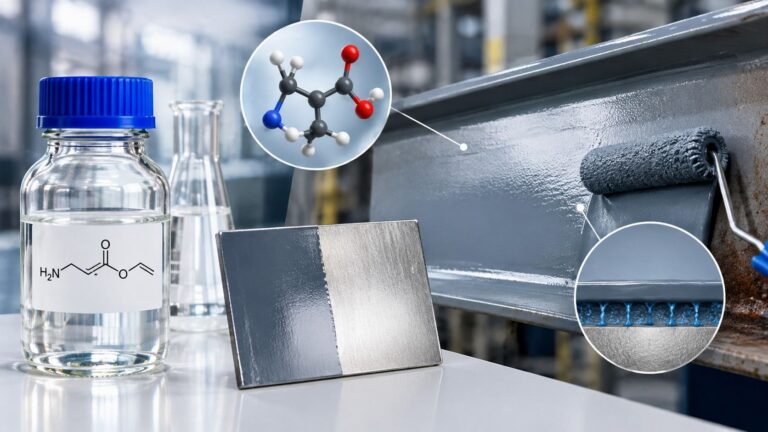
Functional monomers. A functional monomer carries a reactive group such as hydroxyl, epoxy, amino or silane, which gives you control over crosslinking, adhesion and cure. Add one when a plain acrylate or methacrylate copolymer cannot meet a durability or adhesion target.
Textiles and polymer manufacturing. Textile finishing agents rely on soft acrylates and methacrylates for hand-feel and water repellency. Polymer manufacturers copolymerise several monomers to tune strength, processing and film properties, and each added monomer is another line to confirm on the datasheet.
Specifications and Documentation to Request From a Supplier
Ask for three documents before you commit.
TDS. The TDS should confirm the exact monomer identity by name and CAS number, not “acrylic monomer” as a category. It should also state the grade and the typical properties.
Certificate of Analysis (CoA): Ask for the CoA for the batch you will receive. Check the purity and inhibitor content, as these can affect the shelf life and polymerisation behaviour of an acrylate monomer. Also ask how the material is stored, since inhibitors such as monomethyl ether hydroquinone (MEHQ) depend on dissolved oxygen for stability.
Safety data sheet (SDS). The SDS covers handling and storage. Acrylate and methacrylate monomers are reactive and flammable, and heat, light and peroxides can start unwanted polymerisation.
For reference, each Ruifen product page lists CAS number, formula, purity and inhibitor level. The BA page states a minimum purity of 99.5 percent with 10 to 100 ppm MEHQ, while the IBOA page states a minimum purity of 98 percent by gas chromatography. Minimum purity differs by monomer, so ask for lot values instead of assuming one figure fits the whole family. Ask for a retained sample of the lot as well, so you can compare the supplier’s data with your own incoming test. Treat website figures as a starting point and confirm them on the batch CoA.
Questions to Ask a Monomer Supplier Before Ordering
Send these four questions with every request:
- Which specific monomer, by name and CAS number, does this quote cover?
- What inhibitor type and concentration does the product carry?
- Is this an acrylate or a methacrylate, and does the datasheet state which?
- What packaging and storage conditions does the product require?
Send the same four to every supplier so the answers line up side by side. Add your application, target Tg or film property and expected volume, and the supplier can answer for your formulation instead of in general terms.
For repeat orders, add two more: how does the supplier control lot-to-lot variation, and can you receive a sample before a full order? A supplier that answers with names, numbers and documents has already run this process.
| Question | What a clear answer looks like | Warning sign |
| Monomer and CAS | Full name with CAS number | “Acrylic monomer” |
| Inhibitor | MEHQ or another named inhibitor with a ppm level | “Standard stabiliser” |
| Acrylate or methacrylate | Stated on the TDS | Left for you to infer |
| Packaging and storage | Pack type, temperature and atmosphere | “Store in a cool place” |
Buyer Takeaway
Acrylates and methacrylates, both called acrylic monomers on many sites, differ in Tg, hardness and reactivity. The right choice follows from the film or bond you need to build, and side chains can override the family pattern.
Before buying, check the datasheet and make sure the monomer name and CAS number match what you need. Supplier names can vary, so it is worth checking. With an acrylate monomer, look at the functional groups too. A hydroxyl or epoxy group can make a difference to the final formulation. Get the TDS, batch CoA, and SDS before placing the order. If the supplier will not share the exact name or CAS number, do not proceed.
Sourcing Acrylate and Functional Monomers From Ruifen Chemicals
Ruifen lists acrylate and methacrylate monomers in two places. The Acrylates category under High-Purity Solvents holds butyl acrylate, butyl methacrylate, ethyl acrylate, 2-ethylhexyl acrylate, HEMA and IBOA. The Functional Monomers category lists monomers such as isobutyl acrylate and 2-octyl acrylate, plus methacrylates, and the category page describes acrylate, methacrylate, epoxy and silane chemistries.
Each product page identifies the monomer by exact name, CAS number, formula and specification instead of a generic “acrylic” label, which is the standard this guide asks you to hold any functional monomers supplier to. The Functional Monomers page also describes batch-to-batch quality control, documentation and technical guidance on polymerisation and formulation. Every product page carries an inquiry form with an application field, so the team can match your request to your formulation. Name the monomer, its CAS number, your application and your expected volume in the inquiry, and ask for the TDS and a batch CoA with the reply.
Need the technical data sheet for a specific acrylate monomer? Request it from our team and we’ll confirm specifications for your formulation.
Frequently Asked Questions
What is the difference between acrylate and acrylic monomers?
Acrylate monomers are esters of acrylic acid. “Acrylic monomer” is a looser term that some suppliers use for the whole family, including methacrylates, and others use for methacrylates only. Confirm the exact monomer name and CAS number on the datasheet.
What is an acrylate monomer?
An acrylate monomer is an ester of acrylic acid, such as methyl acrylate, ethyl acrylate or butyl acrylate. It polymerises by free radicals and tends to form soft, flexible polymer segments used in coatings, adhesives and textile finishes.
Is methacrylate the same as acrylate?
No. A methacrylate carries an extra methyl group next to the carbonyl. Methacrylate polymers show higher Tg, harder films and different weathering behaviour than the matching acrylates.
Which is harder, an acrylate or a methacrylate?
Methacrylates generally produce harder polymers than acrylates, although the ester side chain also plays a role. For example, butyl methacrylate has a Tg of around 20°C, while butyl acrylate is around -54°C. Isobornyl acrylate has a much higher Tg, near 90°C, due to its bulky structure.
What are the main acrylate monomer applications?
Acrylate monomers are used in surface coatings, pressure-sensitive and laminating adhesives, textile and leather finishing, plastics and resins, UV-curable coatings and inks, and paper coatings. The right monomer depends mainly on the hardness and flexibility required in the final product.
What should I check on a datasheet before buying acrylate monomers?
Check the exact monomer name and CAS number, whether it is an acrylate or a methacrylate, the purity, the inhibitor type and level, and storage conditions. Ask for the TDS, a batch CoA and the SDS.
Does Ruifen Chemicals supply acrylate and functional monomers?
Yes. Ruifen Chemicals lists acrylate and methacrylate monomers under Acrylates in its High-Purity Solvents range and under its Functional Monomers category. Each product page states the monomer’s CAS number and specification.