


Engine oil is naturally thinner at 100°C than it is at 40°C, which can weaken the oil film protecting engine parts. This comes from the base oil itself, as its viscosity drops with heat. A viscosity index improver (VII) reduces that drop. The result is an oil that still flows when cold without becoming too thin when the engine gets hot.
For a polymer producer, a VII is built from monomers, and the monomer mix decides how well the polymer works and how long it lasts. This article explains how a polymethacrylate VII works, assigns each monomer type its role, and lists what to verify when sourcing C12-C14 methacrylates such as Lauryl Methacrylate 1214F (LMA 1214F). Ruifen supplies the monomer, not the finished additive.
How a Viscosity Index Improver Flattens the Viscosity Curve
Base oil thins as it heats, and the viscosity index (VI) is the standard number for that behaviour. ASTM D2270 describes the VI as a single number for the temperature dependence of kinematic viscosity, calculated from readings at 40 and 100 degrees Celsius. A higher VI means a flatter curve, and a VII lifts the VI of the finished oil. That is what lets a multigrade engine oil, one rated for both cold starts and hot running, hold a useful viscosity across the whole range. Without a VII, the oil would have to be thin enough for cold starts and would then run too thin when hot.
The mechanism follows the polymer coil, and each temperature zone plays out in its own way:
- Cold oil. The coil stays compact, so it adds little viscosity.
- Hot oil. The coil expands and thickens the oil, which offsets the base oil’s thinning.
- High shear. The coil can stretch or break, and that is where shear stability becomes a property you have to buy and test.
A US patent on shear-stable hydraulic oils states that polymethacrylate (PMA) modifiers raise the VI, which improves low-temperature properties and increases viscosity at higher temperatures. Polymethacrylates are one of the main VII chemistries, next to olefin copolymers and others. This article stays with PMA, since that is where C12-C14 methacrylates matter.
Monomer Jobs Inside a Polymethacrylate VII
Each monomer family in the recipe controls its own part of the polymer’s behaviour.
Long-chain alkyl methacrylates
These monomers give the polymer its oil solubility and set how the coil responds to temperature. They make up the bulk of the backbone’s side chains. C12-C14 grades fall in this group, and the exact chain mix affects how the finished polymer behaves.
Shorter-chain methacrylates
Shorter-chain monomers are usually used in smaller amounts. They affect how much the polymer coil contracts when the oil gets cold. Changing the balance between shorter and longer chains changes the viscosity-temperature curve. The polymer maker can then adjust the feed to get the required viscosity across the working temperature range.
Polar comonomers
Some formulations also contain a polar monomer. Its role is to give the polymer dispersant properties. The patent discussed above describes this type of viscosity index improver as a copolymer made with a nitrogen-containing monomer. That is a different formulation approach from a standard VII, so it is not covered further here.
For a buyer, the C12 to C14 split in the monomer feed is worth checking. It becomes part of the polymer’s side-chain structure, so even when two materials have the same product name, a different C12-to-C14 split can give different results in the finished polymer.
Sourcing also benefits from this. If the same supplier provides both the long-chain and shorter-chain grades, qualification and documentation are usually easier to manage.
Where Lauryl Methacrylate 1214F Fits
Ruifen’s Lauryl Methacrylate 1214F page (CAS 142-90-5) describes a blend of C12 and C14 fatty alcohol methacrylates. Among its applications, the page lists lubricant additives, where it serves as a primary feedstock for viscosity index improvers and pour point depressants. It also credits the grade with strong oil solubility, which suits a polymer that has to stay dissolved in base oil.
The grade supplies the oil-soluble mid-length side chains that a polymer maker copolymerises with other alkyl methacrylates. It is a monomer input to your own polymerisation, not a finished additive.
The page adds a flash point above 100 degrees Celsius, a density of 0.865 to 0.875 g/cm3 at 20 degrees Celsius, insolubility in water and typical stabilisation with 100 to 200 ppm MEHQ. It describes minimal residual acid and moisture without numbers. Three figures stay open until you ask: the C12 to C14 split, the residual acid and moisture limits, and a purity figure.
Want the grade data in hand before you size a polymerisation batch? See LMA 1214F specifications and request the TDS and packaging options.
Judging the Finished Polymer: Three Numbers Your Customers Test
Your customers do not test the monomer. They test the polymer in oil, so tie each monomer check to a polymer result.
- Thickening efficiency. This is how much viscosity the polymer adds at a given treat rate. The patent notes that higher molecular weight gives better VI lift and thickening efficiency.
- Shear stability. This is how well the polymer keeps its molecular weight under engine shear. The same patent states the trade-off: lower molecular weight gives better shear stability, and high-molecular-weight polymers lose viscosity under shear. It measures permanent shear stability with a permanent shear stability index (PSSI) defined by ASTM D5621.
- Low-temperature behaviour. A VII maker often cares about pour point performance too.
Thickening efficiency and shear stability both follow molecular weight, so your process has to hit a molecular weight target and repeat it. That is where monomer quality enters. General polymer chemistry says acid, water and inhibitor in a monomer feed can shift initiation and chain growth, which moves molecular weight from lot to lot. A varying monomer lot means a varying polymer lot.
The C12-C14 Sourcing Scorecard
Score each supplier on the same five points. Each line states what a pass looks like.
- C12 and C14 distribution. Pass if the CoA reports the measured split, names the method (gas chromatography is the usual one) and states the allowed variation between lots.
- Residual methacrylic acid and acid value. Pass if the supplier gives a numeric limit and a lot value, since acid affects polymerisation and polymer stability.
- Moisture. Pass if the supplier gives a numeric limit and the test method, since water interferes with many polymerisation systems.
- Inhibitor. Pass if the supplier states the type and ppm level and tells you how to handle it before polymerisation. MEHQ needs dissolved oxygen to work, so ask about storage atmosphere too.
- Purity or ester content, colour and CoA method. Pass if the CoA reports each value with its method so that you can compare suppliers on the same basis.
A supplier that answers four of five in numbers has earned a trial. A supplier that answers in adjectives has not.
Watch for these red flags in the replies:
- A CoA with one purity figure and no method behind it.
- A distribution stated as a range so wide that two lots could differ a lot and still pass.
- Acid or moisture described as “low” or “minimal” with no number.
- “Available on request” in place of a document you can read before you order.
From Pilot Pack to Production
One successful CoA does not confirm consistent polymer performance. What matters is how the monomer performs from lot to lot.
- Pilot pack: Ask for a trial quantity and the CoA for the specific lot. Test it using your normal polymerisation process.
- Follow-up lots: Test the second and third lots and check both material variation and finished-polymer results, including molecular weight.
- Production supply: After qualification, shift to drums or IBCs as required. Follow the storage conditions in the TDS and confirm available pack types, MOQs and shipment lead times for both pilot and production orders.
This approach is especially useful when sourcing monomers for viscosity index improver production, where consistent polymer behaviour is important.
Before the first shipment, hold these documents:
- The SDS and the lot CoA.
- The export paperwork your destination country asks for.
- A written notice process for any change in the alcohol source or production site, since either can disrupt the distribution chain.
Keep a retained sample from each lot so you can check it again if a polymer batch starts to drift. Also record the monomer lot number with every polymer result. Without that traceability, it is much harder to investigate or repeat the result.
What to Take Away
- A viscosity index improver polymer helps flatten the viscosity-temperature curve. Its performance depends in part on the monomer mix.
- When qualifying C12-C14 methacrylates, check the distribution, residual acid, moisture and inhibitor levels, then make sure the results stay consistent from lot to lot.
- Treat LMA 1214F as one part of the polymer design. Confirm its split and other specifications against the TDS and CoA.
- If you develop both VII and PPD polymers, use the same qualification process where possible, since many of the monomer checks are the same.
Sourcing Lauryl Methacrylate 1214F from Ruifen Chemicals
Ruifen lists LMA 1214F in its Functional Monomers category. The product page carries a TDS download and an Inquire Now form with an application field. The category page describes batch-to-batch quality control, documentation and technical guidance on polymerisation and formulation, which you can test by asking for a process contact and lot history.
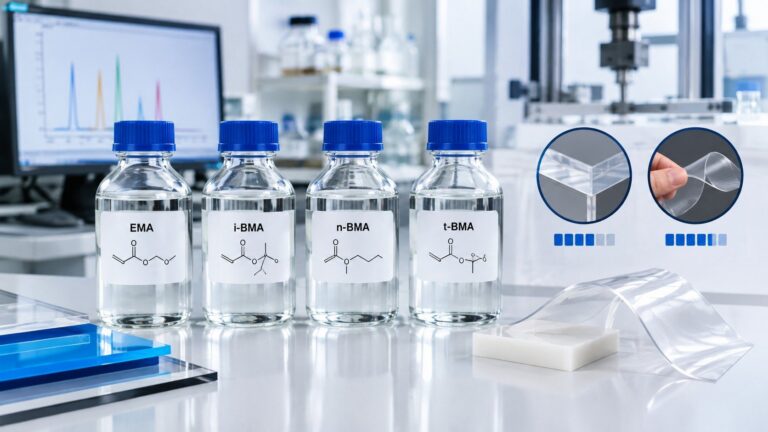
The same category also includes shorter-chain methacrylates such as ethyl, n-butyl and i-butyl methacrylate. Since those pages do not mention viscosity index improver applications, check with the team before using them in a blend.
LMA 1214F suits polymer makers developing their own VII or pour point depressant systems. Ruifen does not manufacture or supply finished VIIs or PPDs, and this article does not suggest otherwise.
Qualifying a C12-C14 methacrylate for your Viscosity Index Improver polymer? Ask for the LMA 1214F specifications or send an RFQ with your volume and destination.
Frequently Asked Questions
What is a viscosity index improver?
A viscosity index improver is a polymer additive that helps oil retain its viscosity as temperature rises. It also helps the oil remain pumpable when cold.
What does viscosity index mean?
Viscosity index shows how much an oil’s viscosity changes with temperature. ASTM D2270 uses viscosity readings at 40°C and 100°C to calculate it.
Which monomers go into a polymethacrylate VII?
Polymethacrylate VIIs use long-chain and shorter-chain alkyl methacrylates. LMA 1214F, a C12/C14 blend, provides mid-chain alkyl groups.
Why does molecular weight matter in a VII?
It affects thickening, VI improvement and shear stability. Higher molecular weight generally gives more thickening, while lower molecular weight can improve shear stability.
What should I ask a lauryl methacrylate supplier for VII work?
Ask for C12/C14 distribution, lot variation, acid value, moisture, inhibitor details, purity, colour and the CoA testing method.
Is lauryl methacrylate the same as a viscosity modifier?
No. Lauryl methacrylate is a monomer. A viscosity modifier is the polymer made from it and other monomers.
Does Ruifen Chemicals supply lauryl methacrylate for VII polymers?
Yes. Ruifen Chemicals lists Lauryl Methacrylate 1214F (CAS 142-90-5) under Functional Monomers. The product page includes a TDS download and inquiry form. Buyers can contact the team for the current CoA, grade details, and packaging options.